


wireless monitoring stereo Audiosystem
General Description
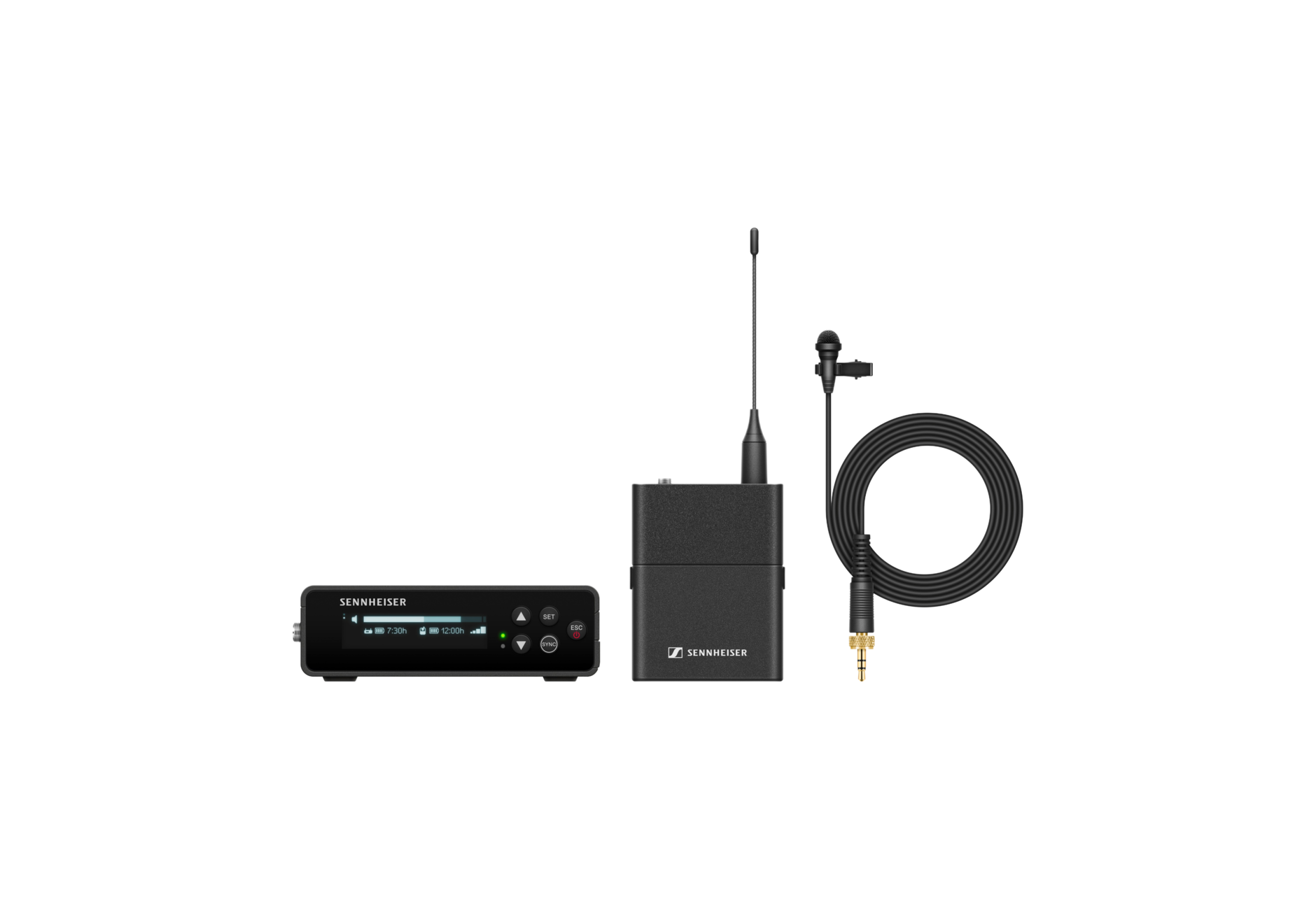
Wireless monitor system with rack-mountable transmitter, bodypack receiver and earphones
Awards
Mix Certified Hit - March 2004 |
Tec Award - 2004 |
Features
- Autoscan on all receivers for simple and secure frequency selection
- 1440 frequencies within a 36MHz switching bandwidth for greater tuning flexibility
- Robust metal construction for durability
- Smaller bodypack transmitters and receivers(30% smaller than current EW)
- Pilot tone squelch(defeatable for backwards compatibility with original EW systems)
- New battery concept(AA cells and rechargeable battery accessories)
- Transmitter battery status telemetry on all models
- Audio signal metering on transmitter LCD display
- External charging contacts on 300 and 500 series bodypacks
- XLR jacks on all rack-mountable units(including 100 series)
- Click here for our limited-time Trade-In Rebate Offer!
Delivery Includes
- 1 SR 300 G2 stereo transmitter
- 1 EK 300 G2 stereo bodypack receiver
- 1 IE 4 earphones
- 1 GA 2 rack mount
- 1 NT 2-1 power supply unit
- 1 telescopic antenna
- 2 AA size batteries
- Operating instructions
- 1 BNC-Cable
CONSUMER ALERT
Most users do not need a license to operate this wireless microphone system. Nevertheless, operating this microphone system without a license is subject to certain restrictions: the system may not cause harmful interference; it must operate at a low power level (not in excess of 50 milliwatts); and it has no protection from interference received from any other device. Purchasers should also be aware that the FCC is currently evaluating use of wireless microphone systems, and these rules are subject to change. For more information, call the FCC at 1-888-CALL-FCC (TTY: 1-888-TELL-FCC) or visit the FCC’s wireless microphone website at
www.fcc.gov/cgb/wirelessmicrophones.
wireless monitoring stereo Audiosystem
Technical Data
| Antenna connector |
BNC |
| Audio output power |
100 mW (32 Ω) |
| XLR connector |
2x XLR3 balanced, 3.5 mm jack |
| Compander |
HDX |
| Dimensions (receiver) |
3.2 x 2.5 x 1 in. (82 x 64 x 24 mm) |
| Dimensions (Transmitter) |
8.3 x 5.7 x 1.5 in. (212 x 145 x 38 mm) |
| Frequency response |
40 - 15,000 Hz |
| Connector (headphones) |
> 100mW (32 Ω) |
| In compliance with |
ETS 300422, ETS 300445, CE, FCC |
| Input voltage range |
+ 10 dBu max |
| Modulation |
FM, MPX-Stereo |
| Operating time |
6-10 h. |
| Operating voltage (stand alone) |
12 V DC nom. |
| Peak deviation |
± 48 kHz |
| Presets |
12 |
| RF frequency range |
518 - 866 MHz |
| Signal-to-noise-ratio |
> 91 dB(A) |
| Switching bandwidth |
36 MHz |
| Total harmonic distortion (THD) |
< 0.9 % |
| Transmission/receiving frequencies |
1,440 |
| Weight (receiver) |
5 oz. (170 g) |
| Weight (transmitter) |
2.4 lbs. (1,100 g) |
wireless monitoring stereo Audiosystem
Recommended Accessories
| Part/Accessory |
Article No. |
| CC 2 |
009826 |
Carrying case for evolution wireless G2 1/3/500 Series, hard-shell polymer, foam lined
|
| GA 2 |
009823 |
Rack mount kit for mounting one or two evolution wireless G2 devices. (not compatable with G1 units).
|
| NTEW-120 |
087246 |
120V power supply for the evolution wireless series
|
wireless monitoring stereo Audiosystem
Variants
Glossary
| Compander |
| Also known as noise reduction system. A system which improves the signal-to-noise ratio by compressing the dynamics on the transmitter side using a compressor, and subsequently restores the normal dynamics on the receiver side using an expander. |
| Frequency response |
| The frequency response of a microphone is given within the limits defined by the manufacturer. In studio condenser microphones it is generally within the range of between 20 Hz and 20 kHz. |
| In compliance with |
| Gives the guidelines and requirements which have to be met before a unit can be put onto the market. Such guidelines are published by e.g. standards committees, telecommunications authorities etc. |
| Input voltage range |
| Indicates the voltage range of the input signal within which a unit will work properly, i.e. as specified in its technical data. |
| Modulation |
| The process in which one wave is varied by some parameter of another wave, for example, an RF carrier frequency that is modulated by an audio signal. Types of modulation include amplitude modulation, frequency modulation, pulse code modulation and pulse width modulation. |
| Operating time |
| States how long a unit can be continuously used with one set of batteries / rechargeable accupack. |
| Operating voltage (stand alone) |
| Voltage type and level required for powering a unit. |
| Peak deviation |
| Maximum permissible deviation for FM. |
| RF frequency range |
| The range of frequencies to which a unit (e.g. a receiver) can be tuned. |
| Switching bandwidth |
| The frequency band in which frequencies can be switched directly. |