


lavalier microphone, clip on microphone
MSRP:$594.92
General Description
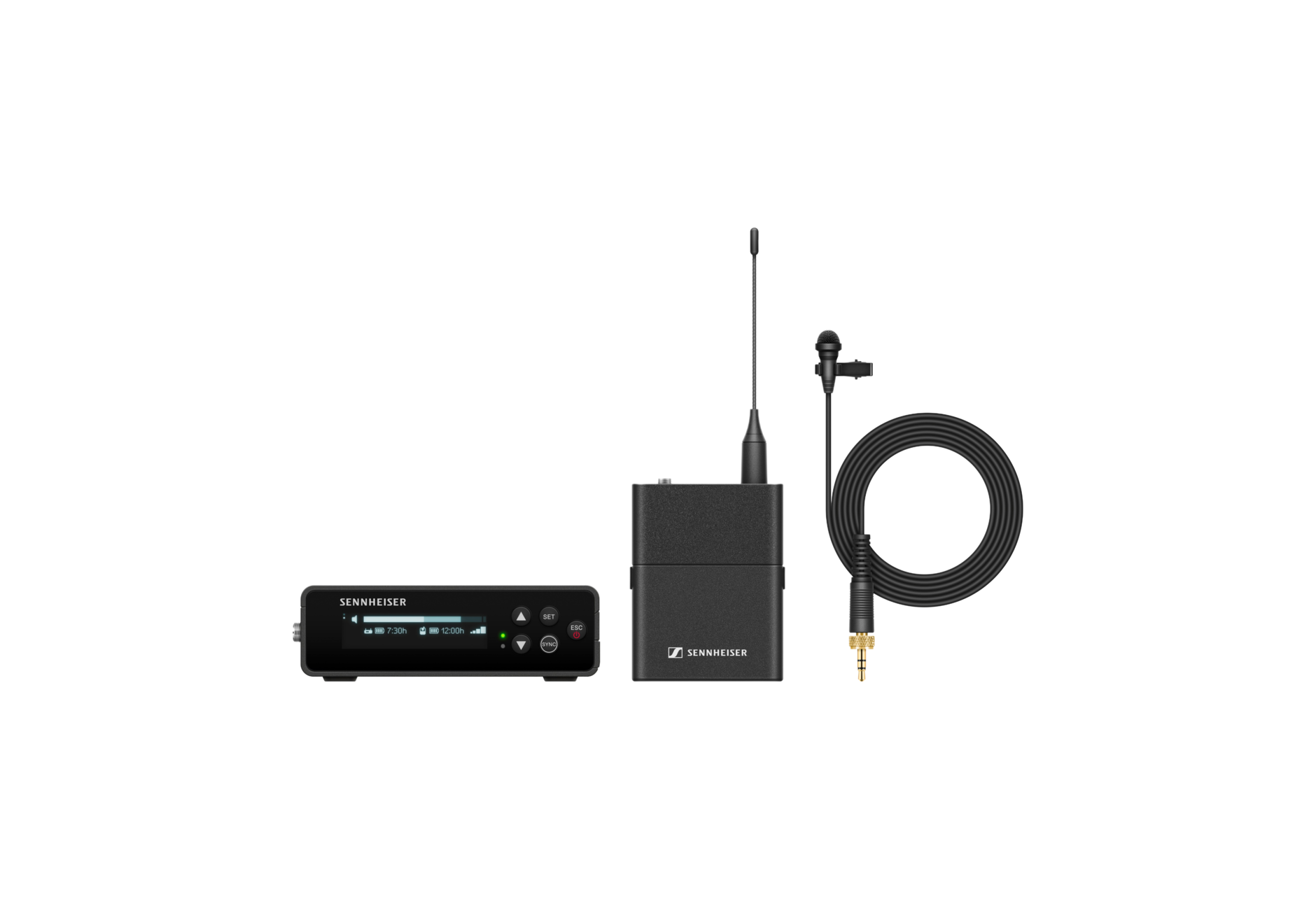
The MKE 2 is a high quality, sub-miniature clip-on lavalier microphone (approx. 4 mm diam.) that serves a multitude of applications. It fulfills the most stringent sound quality demands and is extremely robust. It is suitable for both speech and instrument miking applications in all areas of live work. Color: matte black.
Features
- Flat frequency response
- Good suppression of handling noise
Delivery Includes
- 1 MKE 2 P-C clip-on microphone
- 1 MZC 2-1 cap (short)
lavalier microphone, clip on microphone
MSRP:$594.92
Technical Data
| Cable length |
9.8 ft. (3 m) |
| Current consumption |
2.6 mA |
| Dimensions |
d .48 cm. (4.8 mm) |
| Equivalent noise level |
28 dB |
| Equivalent noise level |
39 dB |
| Min. terminating impedance |
1,000 Ω |
| Nominal impedance |
50 Ω |
| Pick-up pattern |
Omni-directional |
| Power supply |
12 - 48 V Phantom |
| Sensitivity in free field, no load (1kHz) |
10 mV/Pa +- 2.5 dB |
| Weight |
0.04 oz. (1 g) |
| XLR connector |
XLR-3-m |
lavalier microphone, clip on microphone
MSRP:$594.92
Recommended Accessories
| Part/Accessory |
Article No. |
| MZ 2 |
004225 |
Accessory kit for MKE2 with MZQ222, MZQ222-NI, MZW2-A, MZW2-G, ZH100-ANT, ZH100-BEI and case
|
| MZM 2-10 |
USMZM210 |
magnetic microphone holder set with lanyard to clip MKE2, MKE102, or MKE104 over thin clothing
|
| MZQ 22-A |
USMZQ22-A |
|
| MZQ 222 |
076659 |
dual post tie clip for MKE2, MKE102, MKE104, MKE platinum
|
| MZW 2-A |
047185 |
windscreen for MKE2 and MKE platinum (black)
|
| MZW 2-F |
USMZW2-F |
foam windscreen for MKE2 and MKE platinum
|
| MZW 2-G |
047186 |
windscreen for MKE2 and MKE platinum (beige)
|
| NB 2 |
004398 |
head mic adapter designed for the unobtrusive application of MKE2 or MKE102/104
|
| TB-US |
USTB-US |
single clip tie bar for MKE2, MKE102, MKE104
|
lavalier microphone, clip on microphone
MSRP:$594.92
Variants
MSRP:$594.92
Glossary
| Cable length |
| The cable length is usually measured between the anti-kink sleeves of the cable (cable length without connectors). |
| Equivalent noise level |
| The output signal of every microphone always includes a low noise signal in addition to the useful signal. In order to illustrate the extent of the noise voltage, it is given as a fictitious sound pressure level. In an ideally noise-free microphone, a sound pressure level of this magnitude would result in an output voltage of the magnitude of the noise. Self-noise is measured and weighted either in accordance with CCIR 468-3 or – in order to assimilate the measured result with the listening impression of the human ear – in accordance with DIN/IEC 651 (so-called A-weighted). Studio condenser microphones generally have an equivalent noise level of between 20 and 30 dB (CCIR) or between 10 and 20 dB(A). |
| Min. terminating impedance |
| Impedance at which the connected unit meets the specified technical data. If the unit is connected to a lower impedance, it will usually have a lower output voltage or a greater distortion. |
| Nominal impedance |
| See impedance. |
| Pick-up pattern |
| Also known as polar pattern, directivity. According to their acoustic design, microphones differ in their sensitivity towards sound from different directions. Pressure microphones have a sensitivity that is largely independent of direction (omni-directional pick-up pattern). Pressure gradient microphones have the pick-up patterns wide cardioid, cardioid, super-cardioid or figure-of-eight. Interference microphones can be used to achieve a further concentration of the pick-up pattern (lobar pick-up pattern). As a special case, dummy head microphones achieve the pick-up pattern of the human ear/head (dummy head stereo). |
| Power supply |
| Description of the power source used for powering a unit, for example mains, battery, rechargeable accupack, etc. |
| Sensitivity in free field, no load (1kHz) |
| Voltage measured at the unloaded output of a microphone which is exposed to a sound pressure of 1 Pa and a frequency of 1 kHz in an anechoic chamber. |
| XLR connector |
| Most common form of connector in audio studio technology. |