


Condenser Boundary Microphone - for Pianos, Theatre, Opera productions, Altars, Lecterns...
$299.95
General Description
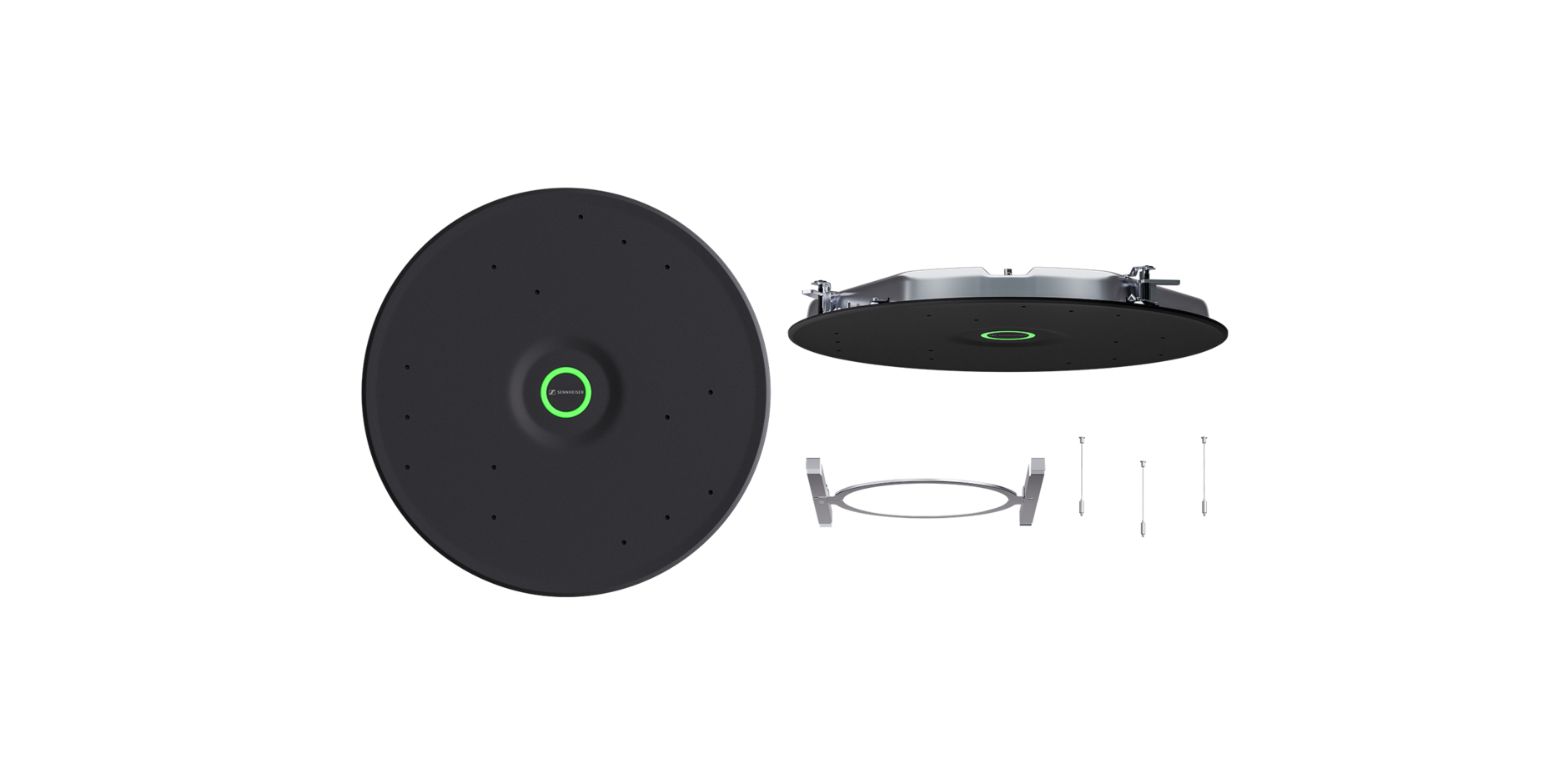
The e 912 is a pre-polarized condenser boundary microphone with half-cardioid pick-up pattern. Its acoustic properties have been optimized for instruments, vocals and speech.
The e 912 is an ideal choice for pianos, theatre and opera productions, conference applications, altars and lecterns. To optimally match the installation environment, the e 912 is available in black or creme white.
Features
- Frequency response and sensitivity optimized for picking up instruments, vocals and speech
- Unobtrusive, flat housing
- Extremely rugged and step-resistant
- Shock-absorbing rubber base
- Mounting slots for table installation
- Gold-plated XLR connector
- Integrated pre-amp
Delivery Includes
- e 912 Microphone
- Pouch
- User manual
Condenser Boundary Microphone - for Pianos, Theatre, Opera productions, Altars, Lecterns...
$299.95
Technical Data
| Dimensions |
5 x 4.1 x 1 in. (126.5 x 105 x 26.5 mm) |
| Equivalent noise level |
26 dB(A) |
| Frequency response |
20 - 20,000 Hz |
| Max. sound pressure level (active) |
135.6 dB |
| Min. terminating impedance |
1,000 Ω |
| Nominal impedance |
< 100 Ω |
| Phantom powering |
48 V / 1,1 mA |
| Pick-up pattern |
Half-cardioid |
| Sensitivity in free field, no load (1kHz) |
10 mV/Pa |
| Transducer principle |
Permanently polarized condenser |
| Weight |
1.2 oz. (550 g) |
Condenser Boundary Microphone - for Pianos, Theatre, Opera productions, Altars, Lecterns...
$299.95
Recommended Accessories
| Part/Accessory |
Article No. |
Condenser Boundary Microphone - for Pianos, Theatre, Opera productions, Altars, Lecterns...
$299.95
Variants
| e 912 BK |
|
Model #500647 |
$299.95 |
| e 912 in black |
 |
$299.95
Glossary
| Equivalent noise level |
| The output signal of every microphone always includes a low noise signal in addition to the useful signal. In order to illustrate the extent of the noise voltage, it is given as a fictitious sound pressure level. In an ideally noise-free microphone, a sound pressure level of this magnitude would result in an output voltage of the magnitude of the noise. Self-noise is measured and weighted either in accordance with CCIR 468-3 or – in order to assimilate the measured result with the listening impression of the human ear – in accordance with DIN/IEC 651 (so-called A-weighted). Studio condenser microphones generally have an equivalent noise level of between 20 and 30 dB (CCIR) or between 10 and 20 dB(A). |
| Frequency response |
| The frequency response of a microphone is given within the limits defined by the manufacturer. In studio condenser microphones it is generally within the range of between 20 Hz and 20 kHz. |
| Max. sound pressure level (active) |
| The maximum sound pressure a unit can reproduce before a given THD is reached. |
| Min. terminating impedance |
| Impedance at which the connected unit meets the specified technical data. If the unit is connected to a lower impedance, it will usually have a lower output voltage or a greater distortion. |
| Nominal impedance |
| See impedance. |
| Phantom powering |
| Almost all studio microphones are supplied with 48V ±4V phantom power (P48, IEC 268-15). This supply voltage is applied to both modulation lines, while the return current flows via the cable screen. Some microphones can also be powered by batteries or from plug-in mains adapters. |
| Pick-up pattern |
| Also known as polar pattern, directivity. According to their acoustic design, microphones differ in their sensitivity towards sound from different directions. Pressure microphones have a sensitivity that is largely independent of direction (omni-directional pick-up pattern). Pressure gradient microphones have the pick-up patterns wide cardioid, cardioid, super-cardioid or figure-of-eight. Interference microphones can be used to achieve a further concentration of the pick-up pattern (lobar pick-up pattern). As a special case, dummy head microphones achieve the pick-up pattern of the human ear/head (dummy head stereo). |
| Sensitivity in free field, no load (1kHz) |
| Voltage measured at the unloaded output of a microphone which is exposed to a sound pressure of 1 Pa and a frequency of 1 kHz in an anechoic chamber. |
| Transducer principle |
| Two transducer principles have become established for the conversion of electric energy into mechanical energy: electrodynamic and electrostatic transducers, whereby the latter is only to be found in audiophile systems, due to their relatively high manufacturing costs. Electrodynamic transducers basically consist of a ring-shaped permanent magnet and an oscillation coil, which is fixed to the receiver diaphragm. When an audio-frequency alternating current is passed through the oscillation coil, it is caused to vibrate in accordance with the audio-frequency alternating current, thus causing the diaphragm to vibrate in the same way. |